
My best friend Marett has spent decades helping run luxury safaris for Abercrombe & Kent and is exceptionally good at accommodating the needs of highly demanding people. Her grandparents founded the company in 1962, and their early camps had antique rugs and crystal martini glasses. The loos were made of mahogany.
She tells me the thing guests complain about most is their eggs.
Apparently, getting a mahogany loo into the bush is easier than perfectly calibrating the texture of each guest’s morning scramble.
Marett likes her eggs soft, almost wet. I tend to agree, but I draw the line at clear, gelatinous albumen. Firm, rubbery eggs are equally unacceptable. Otherwise, I’m easy to please.
My daughter is a very good cook. And, like Marett and me, she is fastidious about how she prepares her eggs. We are both avid home cooks who obsess over our weekly Trader Joe’s hauls.

Recently Olivia started cooking almost all of her meals herself.
Yesterday, I told Olivia that I had made her favorite: slow-cooked Japanese sweet potatoes.
Her right eyebrow immediately shot north. She stepped a little closer, peering dubiously at the gently lacquered tuber in my hand.
“What did you put on them?”
“A tiny bit of olive oil.”
“Mom, you don’t need oil in the air fryer!”
I can almost always find a reason to add olive oil. I am also extremely particular about which one. I have at least five kinds, each with a slightly different flavor profile. I’ve never understood people who swallow it by the spoonful when there is usually a perfectly good loaf of sourdough nearby.
We each spend a considerable amount of effort cooking for one, then try to make the other person eat it.
This morning, I spent a long time contemplating breakfast. The mushrooms needed cooking and I had some cheddar to use up.
I then spent some time investigating what some of my favorite chefs had to say about cooking eggs. There was, not surprisingly, a lot of talk about temperature, timing, and custard. “Let it get kind of creamy and custardy,” Ina Garten told Jennifer Garner on The Pretend Cooking Show. Eric Ripert has also described perfectly cooked scrambled eggs as having “the texture of custard.”
By the time I finished cooking my eggs over low heat with a dab of butter, jammy tomatoes, mushrooms, and cheddar, they were a custardy masterpiece.
Naturally, I wanted my daughter to try them. She was asleep, which I chose to regard as only a minor obstacle.
I stood over her bed with my spoon heaped high.
She opened one eye from beneath the covers and stared at me like a badger whose burrow had been disturbed.
“Want to try my eggs?” I said, maneuvering my spoon under her nose.
She wrinkled her nose in disgust.
“Just try a little bite.”
She disappeared under the duvet.
I would remember this later when she tried to force a bite of her Korean beef bulgogi with furikake and seaweed on me.
Lately, this is how my teenage daughter and I show affection: we cook for ourselves, then insist the other person appreciate it.
The eggs were excellent, by the way. You’ll have to take my word for it.
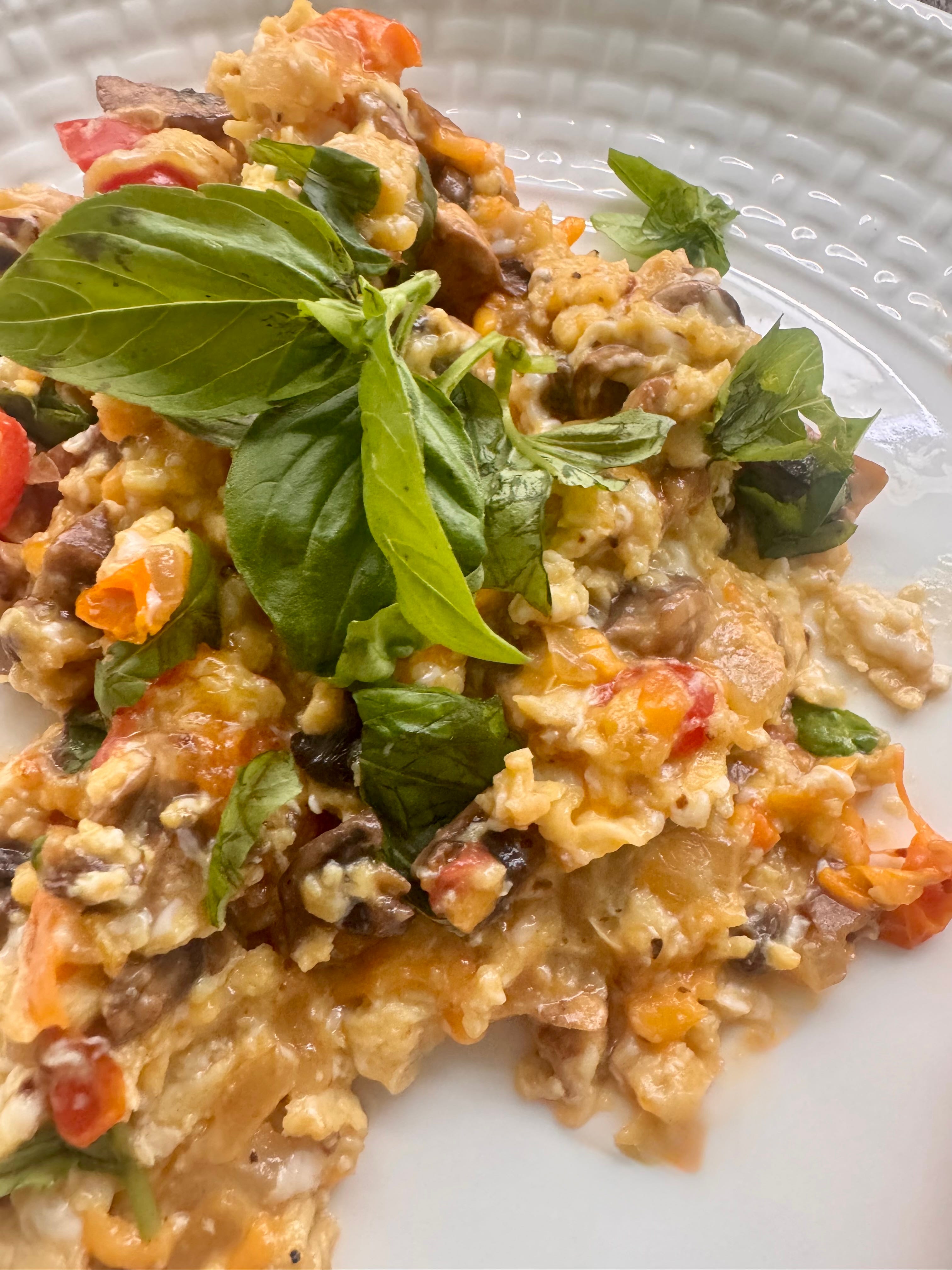
Soft scrambled eggs with jammy tomatoes, mushrooms, cheddar, and basil
Serves one
3 large eggs
A handful of cherry tomatoes, halved
A handful of sliced mushrooms, roughly chopped into ½-inch pieces
2 tablespoons finely chopped onion
½ small garlic clove, finely chopped
2 tablespoons cheddar, finely grated or chopped small
3–4 fresh basil leaves
Olive oil
1–2 teaspoons butter
Salt and freshly ground black pepper
1. Make the tomatoes jammy.
Heat a teaspoon or two of olive oil in a skillet over medium heat, add the tomatoes cut-side down with a pinch of salt, and then leave them alone. After a couple of minutes, start stirring occasionally and let them go for 8–12 minutes, until they’ve softened. Squash a few with your spatula once they’re ready, and let the juices thicken up. Add the garlic in the last minute; it burns fast and gets bitter, so keep it moving. Scoop everything into a dish.
2. Cook the onions and mushrooms.
Wipe out the scorched bits, add another splash of oil, and soften the onion over medium heat for 3-5 minutes. Add the mushrooms and spread them out. Leave them alone for 2–3 minutes so they get some color, then stir. Keep going until the water they release has cooked off and the onions have gone soft and sweet, somewhere around 6–10 minutes, though I mostly just wait until the kitchen smells right. Season, toss with the tomatoes, set aside.
3. Give the eggs a cool pan.
This is the step everyone skips and then wonders why their eggs turned into a hockey puck. Use a clean, small nonstick skillet, or take your vegetable pan off the heat for a few minutes and wipe it out first. Whisk the eggs hard with a pinch of salt until there’s not a streak of white left. You don’t need to add any milk or water (they thin out the egg proteins, making your scramble more fluffy than custardy).
4. Cook low and keep stirring.
Melt the butter over low heat. Add the eggs and start slowly sweeping a spatula across the bottom of the pan, edges to center, scraping the sides. Keep the curds small and soft. If it suddenly looks like it’s setting fast, yank the pan off the burner entirely and keep stirring until it calms back down. Give it 4–7 minutes total. Trust what you’re seeing with your eyes over the timer.
5. Add the cheese with some sense of timing.
If you’re using small chunks or coarse shreds, stir in the cheddar once the curds have formed but the eggs are still loose. If it’s finely grated, you can wait until the pan’s off the heat. Don't keep cooking already-done eggs just to melt a big chunk of cheese. Chop it smaller before you start.
6. Plate it right away.
Pull the eggs off the heat the second they’re soft-curded and creamy, still glossy, with no watery liquid pooling around the edges. Stir in the last of the cheese if you haven’t already. Get them onto the plate right away; this is not a “check your email really quick” situation. Spoon the warm tomatoes and mushrooms over the top, or fold them in off the heat just before serving. Finish with torn basil and a good crack of black pepper.
7. Serve immediately.
Ideally to someone who is conscious and has expressed an interest.
I’m back! I forgot to mention that Pete’s Coffee actually makes frittatas using this recipe—but instead of Greek yogurt, they use non-fat plain yogurt. Their frittatas are so yummy!
I don’t actually cook, LOL. But I read a great article about the best way to cook wet, fluffy eggs for a protein-packed meal, and they’re so good!!! (Someone else made them for me.)
Instead of adding cream, you sub plain Greek yogurt. Then add red peppers, chopped kale, and some feta.
Scramble them or make ‘em into a light frittata. And yum!!!
The feta adds just enough salt and you are DONE!